The setting
Piazza Navona and the Pamphilj palace
From a Roman stadium to a Baroque square: the history of Piazza Navona, its three fountains, the church of Sant'Agnese and the palace the rooftop belongs to.
Reserve a place on the roof ↗Quick answer
Piazza Navona occupies the site of the Stadium of Domitian, built in 80 AD, and keeps its long oval shape. In the 17th century Pope Innocent X, born Giovanni Battista Pamphilj, gave it its Baroque look: Bernini's Fountain of the Four Rivers, the church of Sant'Agnese in Agone and the family palace, where the rooftop opera is held.
A stadium under the square
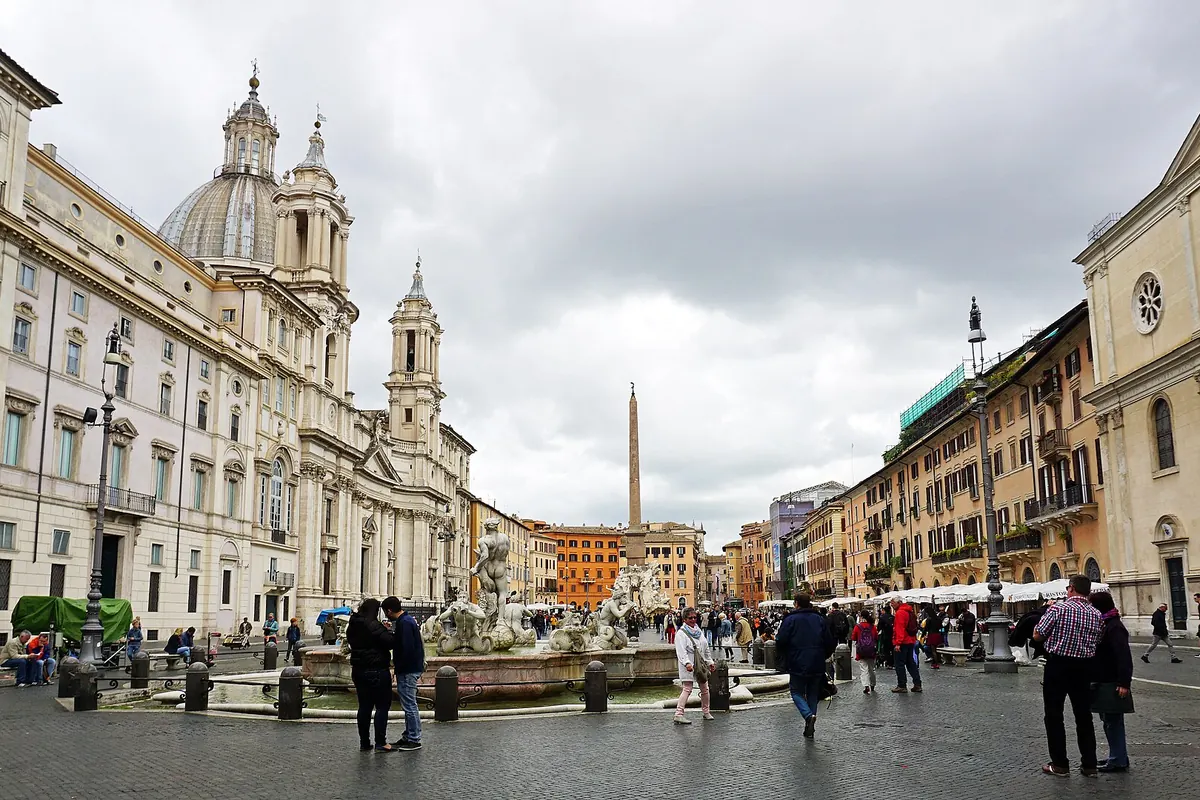
The piazza follows the outline of the Stadium of Domitian, built by the emperor Domitian in 80 AD. Romans watched games there, and the space was known as the Circus Agonalis. The long oval is the reason the square is so unlike other Roman piazzas. The church of Sant'Agnese in Agone carries the same root in its name.
A market and a lake
In the late 15th century the city market moved to the piazza from the Campidoglio, and it stayed until 1869, when it moved to Campo de' Fiori. From 1652 until 1866 the piazza was flooded on weekends in August for elaborate celebrations of the Pamphilj family. The pavement was raised in the 19th century. A Christmas market is held in the piazza each year from the first week of December to the first week of January.
Three fountains
Giacomo della Porta made the Fountain of Neptune at the north end in 1574, and the basin and tritons of the Fountain of the Moor at the south end in 1575. Bernini added the statue of a Moor wrestling a dolphin in 1673. In the centre stands Bernini's Fountain of the Four Rivers, dated 1651, crowned by the Obelisk of Domitian, brought from the Circus of Maxentius. The Neptune statue was added in 1878.
A pope's family square
Giovanni Battista Pamphilj, born in Rome in 1574, was pope as Innocent X from 15 September 1644 to 7 January 1655. His family, originally from Gubbio, made the piazza its stronghold. The fountain, the church and the palace that frame the square all date from his pontificate, and Wikipedia calls Palazzo Pamphilj the family's stronghold in Rome. Innocent X is buried in Sant'Agnese, the church beside it.
Olimpia Maidalchini and the building
When Cardinal Giambattista Pamphilj became pope in 1644, he already owned a palace between Piazza Navona and Via Pasquino. The family bought more land and absorbed neighbouring buildings, including the Palazzo Cibo. His sister-in-law, Olimpia Maidalchini, oversaw and managed the work. Her apartment faced Piazza Pasquino, while the pope's faced Piazza Navona, and a long gallery connected the two. The palace has three courtyards, and the building you see from the piazza is the result of several older houses made into one.
Sant'Agnese in Agone
Work on the church began in 1652 under Girolamo Rainaldi and his son Carlo. In 1653 Francesco Borromini took over, and he resigned in 1657, after which Carlo Rainaldi returned. It is dedicated to Agnes of Rome and served effectively as the family chapel, with an opening in the dome's drum that let the family join services from the palace. The cupola fresco was begun by Ciro Ferri in 1670.
Palazzo Pamphilj
Wikipedia says the palace was built between 1644 and 1650, with Girolamo Rainaldi as architect. Borromini, consulted in 1647, contributed the stucco decoration of the great hall and designed the gallery, which Pietro da Cortona frescoed between 1651 and 1654. The booking page credits Borromini with the palace, and the upper terrace is named for him. Both accounts agree that he worked here, and the Terrazza Borromini is the rooftop's second stage.
Read next: Rome rooftop opera: which one to book
The gallery and its frescoes
Pietro da Cortona decorated the gallery vault between 1651 and 1654 with scenes from the life of Aeneas, drawn from Virgil, whom the Pamphilj family claimed as an ancestor. Because the gallery is long and its vault low, a visitor cannot take in the cycle from one spot, so Cortona organised the scenes around a central painted frame, the Apotheosis of Aeneas. A large Serliana window sits at each end. The gallery is part of the palace but not part of the rooftop ticket.
Seeing the piazza before the roof
The fountains, the church front and the line of the old stadium are all readable from the square itself, so the roof is the second half of an evening that starts at ground level. Take a lap before you go up, and look for the palace's clock tower and the dome of Sant'Agnese, because the Terrazza Borromini sits between them.
Frequently asked questions
Why is Piazza Navona oval?
It follows the outline of the Stadium of Domitian, built in 80 AD.
Who built the Fountain of the Four Rivers?
Gian Lorenzo Bernini made it in 1651, with an obelisk on top.
Who was Innocent X?
Giovanni Battista Pamphilj, pope from 1644 to 1655, whose family built the palace and the church.
Who designed Palazzo Pamphilj?
Girolamo Rainaldi won the commission, and Borromini designed its gallery after being consulted in 1647.
Sources